Materials, design & sleep
Understanding Modular Comfort in Obasan Organic Mattresses
An organic mattress is more than a collection of natural-sounding materials. Its layers, their arrangement, and the possibility of changing them all shape the way a bed feels and how it is cared for over time. Using Obasan as a point of reference, this guide explores what to look for when comparing organic mattress construction—and which questions help turn broad claims into useful details.
The landscape beneath the sheets
A mattress is a small landscape of materials. Beneath the fitted sheet, layers may compress, spring back, spread pressure, and move heat and moisture away from the body. Two mattresses described as organic can behave quite differently, because the words on a label tell only part of the story. The materials matter, but so do their thickness, density, placement, cover, and the way the whole structure is assembled.
Obasan is a useful reference point for examining these questions because its organic mattresses are associated with layered construction and configurable comfort. This article is an educational guide, not a claim that every Obasan model uses the same components or offers the same adjustments. Mattress specifications can vary by model and change over time, so consult the current product description and manufacturer for details about a particular bed.
The most useful starting point is not a promise of perfect sleep. It is a clear account of what is inside, how the layers work together, and what can be changed if the initial feel is not quite right.
What “organic mattress” does—and does not—tell you
“Organic” is a description that should be connected to specific materials and, where relevant, certification. It does not automatically describe the firmness, durability, comfort, or environmental impact of an entire mattress. A mattress may contain organic fibers in its cover, wool in a quilted layer, or certified latex in a core; the proportions and certifications are important to understand.
Read the materials list as an inventory rather than a headline. Look for the named fibers and foams, how much of each is used if that information is available, and the location of each component. A cotton cover and a latex support core perform different jobs. Wool used in a quilted surface is not the same construction as wool wrapped around a separate comfort layer. Clear descriptions help distinguish these arrangements.
Certifications also have defined scopes. A certificate may apply to a raw material, a textile, a processing facility, or a finished product. Ask which component is certified, which standard applies, and whether documentation is available. An organic claim about one component should not be assumed to cover every part of the mattress, including adhesives, thread, or the finished assembly.
Useful questions include:
- Which materials are present in each layer, from the sleep surface to the support base?
- Are the materials natural, synthetic, or a blend—and are proportions stated?
- What certification applies to each material or component?
- Does the certification describe the finished mattress or only a named part?
- Are any adhesives, fire barriers, or other construction materials used?
Layers are a system, not a shopping list
In a layered mattress, each component contributes to the overall response. A softer upper layer may allow the shoulders and hips to settle, while a firmer layer beneath it limits how far the body sinks. A support core bears much of the load and helps the surface recover after movement. The cover and quilted materials influence the first impression, but the deeper layers matter too.
Latex, for example, is often chosen for its elastic, responsive feel: it compresses under pressure and pushes back rather than slowly conforming in the same way many memory foams do. But “latex” alone does not predict comfort. The type of latex, its firmness, thickness, and position in the mattress all influence the result. Even mattresses made with similar materials may feel distinct because their layer proportions differ.
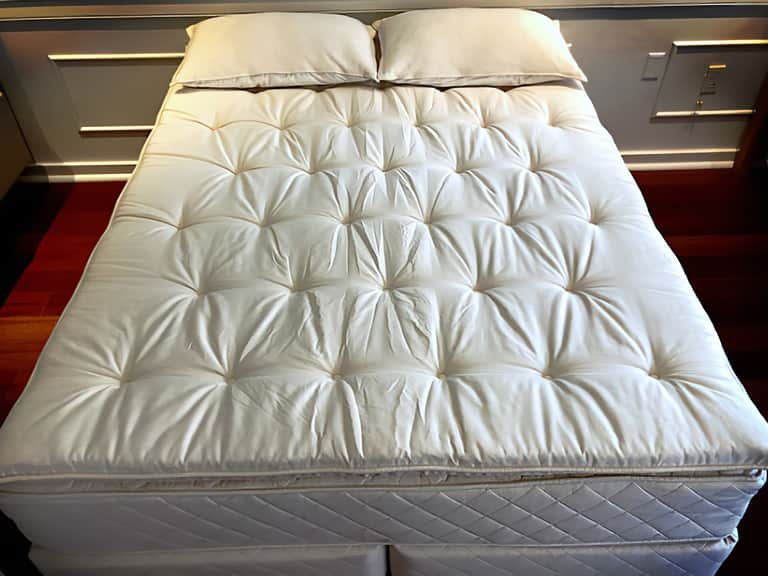
Wool and cotton can contribute to the cover or quilting, adding texture and affecting how the surface manages moisture and heat. Their presence is not a substitute for examining the core. A natural-fiber cover over a particular support system will not necessarily feel like another mattress with the same cover but a different arrangement beneath it.
To picture the construction, imagine pressing a hand into the bed. The first sensation comes from the cover and upper layers. The next comes as the body’s weight reaches the deeper comfort and support layers. A mattress’s feel emerges from this sequence—not from any single material in isolation. This is why a detailed layer diagram, with thicknesses and material names, is often more informative than a general label such as “plush” or “natural.”
What modular comfort means
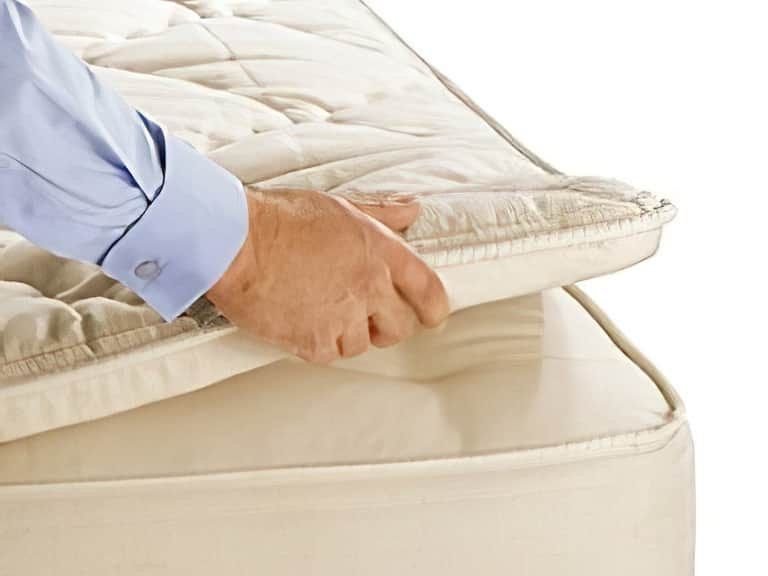
Modular mattress design generally refers to a construction in which some layers can be rearranged, replaced, or selected in different firmness options. The term can describe several different arrangements, however. In one design, a comfort layer may be repositioned. In another, a component can be swapped for a firmer or softer version. Some mattresses offer separate configurations for the two sides of a bed; others do not.
These distinctions matter. “Adjustable” may mean a choice made when ordering, an adjustment available after delivery, or simply a layer that can be accessed. Ask what the maker means by modular and what the owner can practically do. If a component can be replaced, clarify whether the replacement is included, what it costs, how long it remains available, and whether changing it affects the warranty.
With a modular design, comfort can be approached as a process rather than a single irreversible decision. A sleeper may discover that the surface feels too firm after several nights, for instance, and then consider whether a documented adjustment is possible. That flexibility can be valuable, but it is not a guarantee that every discomfort can be solved by changing layers. Fit depends on the sleeper, the bed base, sleep position, body shape, and personal preference.
When assessing an Obasan mattress or another layered design, ask for a precise explanation of its adjustment options. Find out which layers are removable, whether they can be reordered, and whether each side can be configured independently. The answers should describe a practical feature, not leave the shopper to infer one from the word “modular.”
Matching firmness to the sleeper
Firmness is a familiar word with an imprecise meaning. One person’s supportive surface may feel unyielding to another. Firmness ratings can offer a rough comparison within a maker’s own range, but they are not a universal scale shared by every brand. The sensation also changes with the mattress’s layers, the sleeper’s weight distribution, and the foundation beneath it.
Sleep position provides a useful starting point, not a rulebook. Side sleepers often pay attention to pressure around the shoulders and hips, while back sleepers may look for a balance that supports the lower back without making the surface feel harsh. Stomach sleepers may prefer a surface that limits excessive sinking through the midsection. These are broad considerations, not medical advice or a prescription for a particular firmness.
Couples add another dimension. Partners may have different preferences, movement patterns, and body sizes. Ask whether the mattress supports distinct comfort configurations on each side and how the division is handled beneath shared bedding. If the options are not independent, consider how the common surface will feel for both sleepers.
A trial period, if offered, can help reveal a mattress’s everyday feel. Check the exact terms before purchase: how long the trial lasts, whether there are setup requirements, how returns are arranged, and whether fees apply. A showroom test gives a brief first impression; time at home can show how the mattress feels across different nights and sleep positions.
Temperature, airflow, and the sleeping microclimate
People sometimes describe a bed as “cool” or “hot,” but temperature comfort is influenced by more than the mattress. Room conditions, pajamas, sheets, duvets, individual physiology, and airflow around the bed all play a part. A mattress’s materials and construction may contribute to the sleeping microclimate, but no material can guarantee that every sleeper will stay cool.
Latex is often associated with a more buoyant feel than deeply conforming foams, and some latex constructions use openings or channels to promote airflow. Yet ventilation depends on the whole design. A dense core, a tightly quilted surface, and the bed base can affect how air moves. Wool and cotton are frequently included in bedding because they can manage moisture, but the feel depends on their quantity and placement.
Ask which materials sit closest to the body, whether the mattress has a breathable cover, and what kind of foundation the maker recommends. A solid platform and a slatted base may provide different ventilation conditions. Confirm that the support surface meets the mattress maker’s requirements; an unsuitable base may affect performance or warranty coverage.
Care begins with knowing what can get wet
Layered organic mattresses are not necessarily machine washable, and natural materials can need careful handling. The cover may be removable without being washable. An inner layer may be spot-clean only, while a separate protector can be laundered regularly. Before cleaning, follow the specific care instructions for the model rather than applying a general method intended for sheets or a washable mattress pad.
A breathable, well-fitting protector can help reduce the amount of dust, perspiration, and accidental spills that reach the mattress. Choose one that fits the mattress depth and does not bunch beneath the fitted sheet. If you are comparing a protector with a comfort-enhancing pad, remember that the two products serve different purposes: a protector is primarily a barrier, while a pad may add cushioning. Either can change the surface feel to some degree.
For routine upkeep, use the maker’s recommendations on airing, rotating, or turning the mattress. Not every design should be flipped, and not every mattress needs the same schedule. Modular layers may have orientation or placement instructions. Keep those instructions accessible, especially if components are moved or replaced.
When a spill occurs, speed and restraint are both useful. Blot rather than scrub, avoid soaking internal materials, and do not use heat or cleaning agents unless the manufacturer permits them. Moisture trapped inside a mattress can take a long time to dry. When in doubt, contact the maker for instructions before taking the cover apart or applying a treatment.
Durability is a question of construction and care
No mattress lasts forever, and a material’s natural origin alone does not establish its lifespan. Durability depends on factors such as material quality, layer density, construction, use, support underneath the mattress, and care. A warranty can describe how the maker handles certain defects, but it is not the same as a promise that comfort will remain unchanged for a stated number of years.
Read warranty terms carefully. Note the length of coverage, what counts as a defect, how sagging is measured, and which conditions could void the warranty. Requirements may include using an approved foundation or a mattress protector. Ask whether replacing a modular layer is considered a repair, an optional upgrade, or an owner expense.
Also consider the practical life of individual components. A replaceable comfort layer may offer one path for updating a bed, but only if the correct replacement is available and compatible. Ask whether the manufacturer expects to supply parts for the foreseeable future and how a replacement affects the mattress’s feel as a whole. A clear maintenance plan can be as valuable as a long list of materials.
A focused checklist for comparing organic mattresses
When product descriptions grow dense with terms, return to a short set of questions. The aim is not to find a universally perfect mattress, but to understand the choices well enough to decide whether a particular construction suits your needs.
- Materials: Is every layer identified, including the cover, quilting, comfort layers, and support core?
- Composition: Are blends and material proportions explained, or are broad labels doing all the work?
- Certifications: Which components are certified, to what standard, and where can the documentation be checked?
- Layer design: Are thicknesses, firmness options, and the purpose of each layer described?
- Modularity: Can layers be changed after purchase, and what are the costs and conditions?
- Fit: Does the available firmness range align with your preferred sleep position and pressure comfort?
- Temperature: What construction features may affect airflow, and what role does the bed base play?
- Care: Which parts can be washed, spot-cleaned, rotated, or replaced?
- Support: What foundation is recommended, and how does it affect warranty coverage?
- Ownership: What are the trial, return, delivery, repair, and warranty terms?
Reading the details behind the label
Obasan provides a useful context for considering a broader truth about organic mattress shopping: the story is in the construction. A natural-material claim may catch the eye, but a layer-by-layer description reveals how the bed is designed to work. Modular comfort adds another question—whether the design lets the sleeper make meaningful changes, and under what conditions.
Take time to separate evidence from interpretation. A certification establishes that a defined standard applies to a particular material or process; it does not automatically establish how comfortable a mattress will feel. A “breathable” description points to a design intention, not a guarantee of a cool night. A long warranty describes a set of terms, not a fixed lifespan for every sleeper.
The strongest comparison is specific. Identify the layers, check the scope of certifications, learn which adjustments are genuinely available, and understand care requirements before the mattress arrives. Then consider how those details relate to your own sleeping habits, bedroom environment, and preferences. In the quiet geography of a bed, small differences in layer and material can shape the experience above them. Knowing what lies beneath is the first step toward choosing with confidence.
Frequently asked questions
Does “organic” mean an entire mattress is certified?
Not necessarily. A certification may cover a specific material, component, or process. Check the certificate’s scope and the manufacturer’s current documentation rather than assuming the label applies to every part of the finished mattress.
Is a modular mattress always adjustable after purchase?
No. The term can refer to different designs, including options selected at purchase or layers that can later be moved or replaced. Ask what adjustments are possible, who performs them, and whether parts or service involve additional costs.
Can an organic mattress cover be machine washed?
Only if the care label or manufacturer says so. Some covers are removable but not washable, and internal layers may require spot cleaning only. Use instructions for the specific model to avoid damage or trapped moisture.
How should I compare mattress firmness?
Use firmness ratings as a broad guide, then compare the construction, trial terms, and your own comfort preferences. Ratings may differ between brands, so a numerical label is not a universal measure of feel.